
Our Reports
March 2026
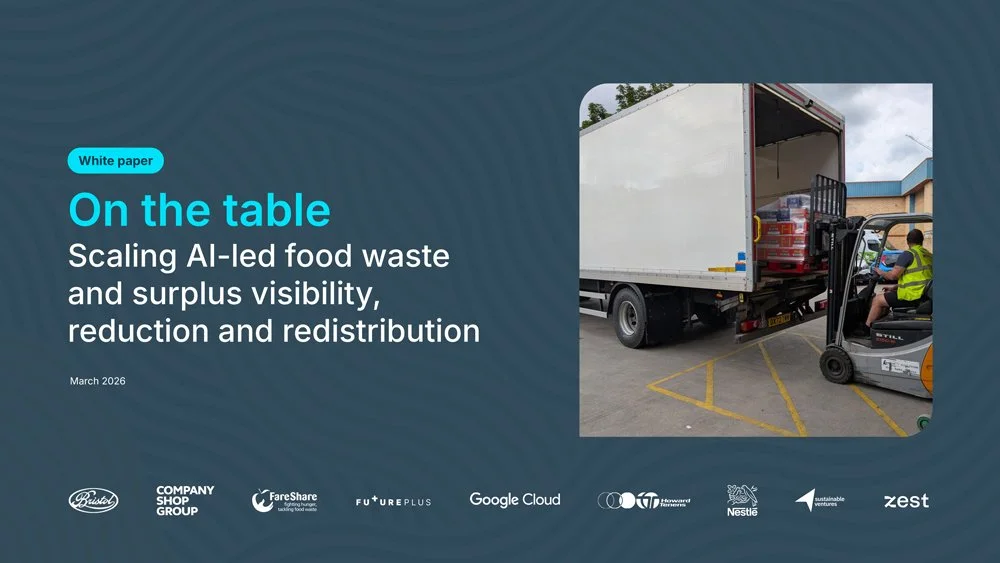
Businesses and food charities came together to pilot a first of a kind AI solution to visualise food waste, reduce it and redistribute unavoidable surplus to people - the equivalent of 480,529 meals. This food supported an estimated 94,133 people across hundreds of charities and organisations, with more food going to people rather than animals or waste. The project showcases how these solutions in partnership can be scaled at speed to build a more efficient food sector.
Over the last 16 months, a nine partner consortium piloted Zest's AI-led solutions, built on Google Cloud that addressed this challenge. The AI-led food waste project was funded through a £1.9 million match-funded BridgeAI grant from Innovate UK. The scope, feasibility and benefits of these innovative solutions were tested by Bristol Superlight, Company Shop Group, FareShare, FuturePlus, Howard Tenens, Nestlé UK&I, Sustainable Ventures and Zest to de-risk its full scale implementation.
Sustainable Ventures has produced a White Paper - “On the table: Scaling AI-led food waste and surplus visibility, reduction and redistribution” which recommends how these solutions could be scaled.
March 2026
Scaling regional industrial strengths will be critical to maintaining the UK’s global climate tech leadership, according to a new report from Sustainable Ventures and Barclays. While widening disparities between London and the regions risk slowing the scale-up of promising companies, our report, Harnessing UK regions as the engines for national economic growth through climate tech, outlines how government and industry can help regional clusters scale climate tech companies.
September 2025
Artificial intelligence is rapidly emerging as a powerful tool for climate innovation, with growing evidence of its ability to help curb emissions and resource use across critical sectors. However, its deployment is not without trade-offs. Given AI’s own energy demands, achieving net climate benefits will depend on targeting its use toward the most impactful challenges.
Early-stage companies are a critical part of this equation. They are key to developing many of the innovative breakthrough solutions needed to decarbonise tough-to-transform industries, yet often face the steepest barriers to adopting advanced technologies like AI.
This white paper reports from the frontline of AI adoption in the sector, exploring where momentum is building, where systemic gaps remain, and what it will take to ensure AI is effectively unlocked as a key climate solution.